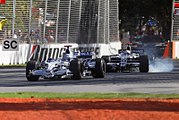
A Formula One Grand Prix event spans a weekend, beginning with two free practice sessions on Friday (except in Monaco, where Friday practices are moved to Thursday), and one free practice on Saturday. Additional drivers (commonly known as third drivers) are allowed to run on Fridays, but only two cars may be used per team, requiring a race driver to give up their seat. A Qualifying session is held after the last free practice session. This session determines the starting order for the race.
Qualifying
The format of the qualifying session has been through several iterations since the 2003 season. Attempts were made to reinvigorate interest in the qualifying session by using a "one-shot" system in which each driver would take turns on an empty track to set their one and only time.
For the 2006 season a knock-out qualifying system was introduced and remains in use, with some minor alterations, in 2008. The qualifying session is split into three phases. In the first phase, all twenty cars are permitted on the track for a twenty minute qualification session. Only their fastest time will count and drivers may complete as many laps as they wish. At the end of the first session, the slowest five cars are eliminated and will take no further part in qualifying. These cars will make up the last five grid positions in the order of their times.
The times for the fifteen remaining cars are reset for the next fifteen minute session. The slowest five cars will make up the grid in positions 11 to 15 in the order of their times set in this session.
The recorded fastest times for the ten remaining cars are then wiped in preparation for the final (ten minute) session referred to as the 'Pole Position Shootout'. At the end of this period, the cars will be arranged on the grid in positions one to ten in accordance to their fastest lap time. In the first two sessions, cars may run any fuel load and drivers knocked out after those sessions may refuel ahead of the race. However, the top-ten drivers must start the race with whatever fuel was left in the car at the end of the final qualifying session. For all the sessions, if a driver starts a timed lap before the chequered flag falls for the end of that session, their time will count even if they cross the finishing line well after the session has ended.
The race
The race begins with a warm-up formation lap, after which the cars assemble on the starting grid in the order they qualified. If a driver stalls before the parade lap and the rest of the field pass him, then he must start from the back of the grid. If he manages to drive off and at least one car is behind him, he is permitted to retake his original position. A racer may also elect to start from pit-lane if he has any last minute problems with the car. If they choose to do this, they must wait for all cars to pass pit-lane before they may begin the race.
A light system above the track indicates the start of the race. The race distance is equal to the least number of complete laps which exceed a distance of 305 km (190 mi) (although Monaco is 260 km (160 mi)), and are limited to two hours. In practice they usually last about ninety minutes. Throughout the race, drivers may make one or more pit stops in order to refuel and change tyres. Teams are supplied with tyres exclusively from Bridgestone. Bridgestone have developed four tyre compounds of which they then select two for the teams to use at a given race event. Drivers must use both tyre compounds during a race for at least one stint except when it rains and drivers switch to either intermediate or extreme wets, then they are no longer required to use both sets of dry tyres. Creating the usage of both types of tyres was introduced in the hope of bringing more excitement to the sport. The softer of the available compounds for the weekend's tyres can be seen with a green stripe on the tyre's sidewall.
When a driver comes round to lap another, the latter must move out of the way within three blue flags (waved by the trackside marshals), or face a penalty from the race stewards.
Points system
Various systems for awarding championship points have been used since 1950. The winner of the two annual championships are the driver and the team who have accumulated the most points at the end of the season. In the case of a tie in points, the championship is awarded to the driver or team having the higher number of wins; if these are equal, second place finishes are considered, and so on.
To receive points a racer need not finish the race, but at least 90% of the winner's race distance must be completed. Therefore, it is possible for a driver to receive some points even though he retired before the end of the race. In that case the scoring is based on the distance completed in comparison to other drivers. It is also possible for the lower points not to be awarded because insufficient drivers completed 90% of the winner's distance. The system was revised in 2003, and as of 2008 points are allocated as follows:
| 1st place | 10 points |
| 2nd place | 8 points |
| 3rd place | 6 points |
| 4th place | 5 points |
| 5th place | 4 points |
| 6th place | 3 points |
| 7th place | 2 points |
| 8th place | 1 point |
In late 2008 Bernie Ecclestone proposed the use of a medal system, much like the Olympics, in order to decide the driver title; however, the points system would still be kept to decide the constructors' championship. The driver with the most golds at the end of the season would be declared champion and if tied then the one with the most silvers would be and so on. This was suggested as a way to make drivers race for places rather than simply "circulate" throughout a race and make sure they bring home points. At the time of writing neither the newly formed FOTA or the FIA have agreed that this system should be used.


0 comments:
Post a Comment